
RESIDENTIAL INTERIOR DESIGN PROJECT
DR. INDIANA JONES' LIBRARY
 |
 |
CLIENT & DESIGN REQUIREMENTS Dr. Indiana Jones is a well-traveled and well-known archeologist who has recently purchased a property in a high rise building in San Francisco, where he would like to reconstruct the penthouse that once existed on the 35th floor. Dr. Jones would like to use this space as a library where he can store his ever growing collection of archeology books, as well as a place to display some of the artifacts he’s collected for himself through his travels. Being that some of his possessions are quite valuable he would like to have an area of the penthouse accessible only through a secret door, perhaps hidden behind one of the bookcases, where he could store some of his most prized acquisitions. Since some of these are ancient relics he would like for this area to be climate controlled, as to ensure the longevity of the artifacts. In addition to functioning as a library, Dr. Jones would appreciate a seating area, where he can read, perhaps entertain some friends, and enjoy the grand view of the city. He would also appreciate a half bathroom in the space so as not to have go downstairs and use the building’s public facilities. |
HISTORICAL RECONSTRUCTION PERIOD: EGYPTIAN ART DECO
Dr. Jones is very interested in the style of Art Deco, and specifically the type of design that occurred during the 20’s with the revival of Egyptian design. Upon researching the space, several photos were found that confirmed that the outside of the building was once indeed Egyptian Art Deco. The façade was painted and adorned with Egyptian columns and Egyptian motifs of Egyptian men and women and lotus flowers emerging from the ground.
Egyptian design has had two significant revivals in American history—one in the 1800s and another in the 1920s. After the discovery of the Rosetta stone in Egypt in 1799, by an officer in Napoleon’s army, there was a surge of public interest in all things Egyptian. In the U.S. this was followed by the construction of Egyptian-style buildings, especially on the east coast and in the mid-west. These were primarily large, publicly-financed structures (such as prisons, hospitals, cemeteries, etc.) rather than commercial or residential buildings.
Once again in the 1920’s after the discovery of the tomb of Tutankhamen in 1922 by Howard Carter, the “Boy King” caught the imagination of the American public. The fact that Carter was being assisted by archeologists and photographers from an American museum, the Metropolitan Museum of Art in New York, added to the sense of national pride and personal involvement in the discovery. Buildings and structures started to be designed with Egyptian motifs and architecture, often times combined with the existing design style of the time, Art Deco.
In addition to the excitement due to this discovery, and the prolonged media attention (the project of clearing and cataloging the tomb lasted 10 years, from 1922-1932), other factors encouraged this type of construction. Throughout most of world, architects and designers were searching for different ways to express the rapid growth of a new lifestyle after World War I. Modern architects were trying to create new projects which were completely different from styles of the past. To create this, designers often reached into foreign and ancient cultures for inspiration such as African, Aztec, American Indian and Oriental. However, with the discovery of Tut’s tomb, ancient Egyptian motifs began to rival all other popular designs. The clean lines and strong geometric qualities of the Egyptian architecture lent themselves well to the existing lines of Art Deco, and so these designs began to be applied to everything from jewelry to apartment houses.
In addition to the flat roofs and courtyards, prevalent in Egyptian design, other design elements began to be implemented in buildings. A common feature was incised stucco walls made to look like sandstone blocks, which often angled out at the bottom and tapered at the top. Often centered below the upper cornice was a bas relief of an ancient Egyptian design. Most Egyptian Revival buildings have columns made to resemble the Ancient Egyptian designs of papyrus stalks that were banded just below, flaring the top. The columns and walls also may have exotic designs or hieroglyphics which were copies from tomb paintings.
The popularity of the Egyptian style began to wane with the introduction of the streamlined modern design of the 1930’s. In spite of its relative short life, there are still many examples of Egyptian architecture as can be seen in this article:
DESIGN IMPLEMENTATION
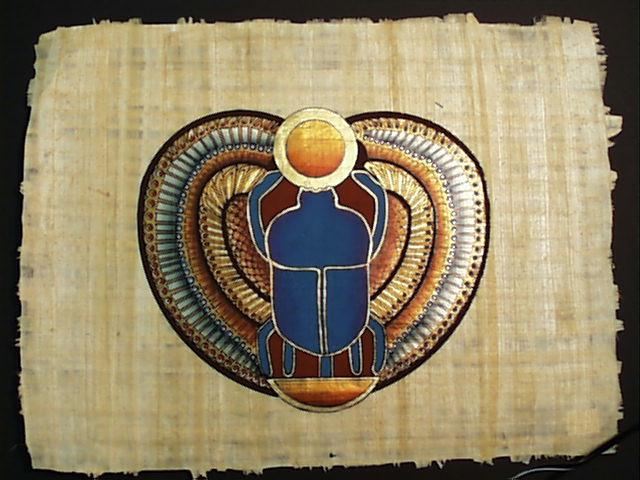
Design was loosely inspired and based on the shape of the scarab beettle, a well known icon and symbol of Ancient Egyptian culture. In the center of the structure is a glass cylindrical elevator which provides alternate access (besides the stairs) to both the library and lounge areas, which are located at each extreme of the structure. In the center there is also a bathroom and viewing lounge areas. As required by Dr. Jones, the library has a false panel which pivots and opens up to the secret storage area behind. A circular staircase provides access to the the upper library floor. Glass block walls are used throughout to define spaces and provide some privacy to each area.
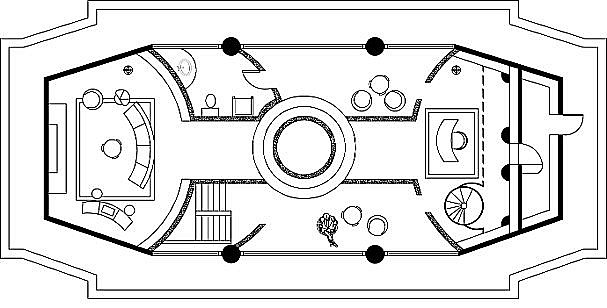
FLOOR PLAN
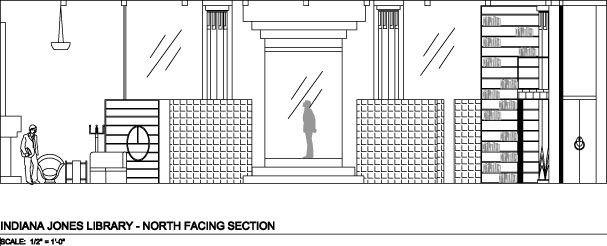
SECTION OF ENTIRE SPACE CUTTING THROUGH MIDDLE
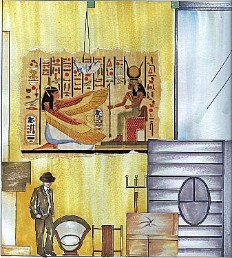 Section of Lounge Area 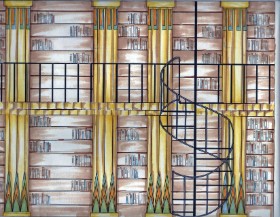 Elevation of Library with Secret Passageway Door | 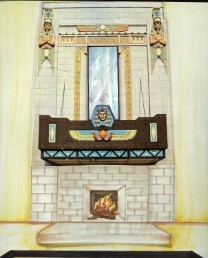 Elevation of Fireplace in Lounge 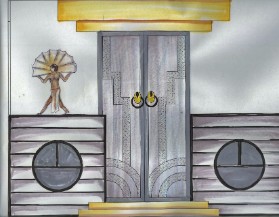 Elevation of Elevator View from Lounge |
FURNITURE & FINISHES
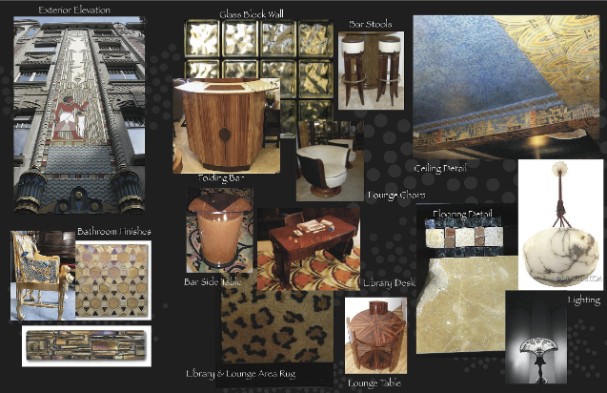
Furniture and finishes reflect the Art Deco period but have a definite Egyptian feel and flare wherever possible. Alabaster lamps, Macassar Ebony tables and Glass mosaic tiles are some of the finishes that help bring forth the feel and opulence of the period. The flooring is yellow marble and is accented by a marble mosaic pattern. The ceiling is detailed with an Egyptian motif in gold leaf. The walls are painted in a papyrus finish and a mural is painted in the lounge walls. There are large Egyptian columns on the library that go the whole extent of the 16' walls.
EXTERIOR ELEVATIONS
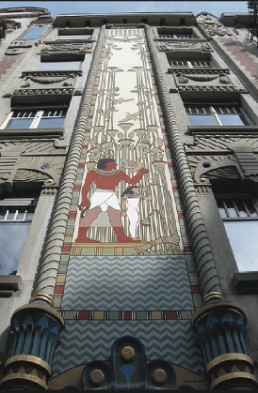 Exterior Elevation from Street | 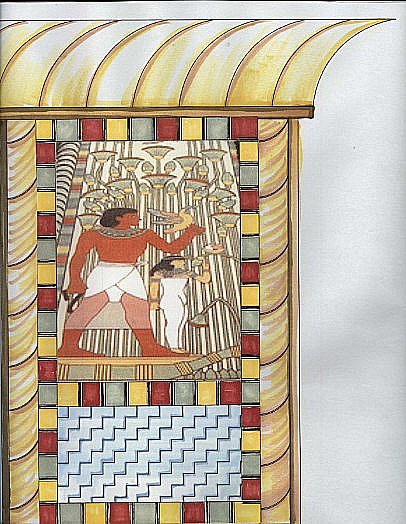 Exterior Elevation of Penthouse Apartment |
